src/examples/wall-model.c
Turbulent flow in a channel with a “wall model”
This is a variant of this example which solves the entire turbulent flow profile in a channel with a viscous sublayer and Prandtl’s “mixing length” turbulence model.
The goal is to exclude the small scales and strong gradients associated with the viscous sublayer and its transition toward the log profile, to drastically reduce the necessary mesh refinement.
The configuration is the same but the left boundary of the channel is reduced by a small amount y_c on which a special boundary condition is applied: a “wall model”.
#include "grid/bitree.h"
#include "run.h"
#include "diffusion.h"
The parameters are the acceleration G, the fluid viscosity \nu and the width of the channel W (including the viscous sublayer etc.).
const double G = 1., nu = 1e-4, W = 1. [1];
const double kappa = 0.41 [0]; // von Karman constant
The left boundary is set at y_c, a small value compared to W but sufficient to exclude the viscous sublayer, since y_+ = y_c\nu/u_\star = 10 here.
double yc = 1e-3;The numerical parameters are the minimum and maximum level of refinement.
int minlevel = 5, maxlevel = 11;Wall model
To construct the left boundary condition at y = y_c, we start from the full analytical solution (see Lagrée, 2026 p.34) u_+ = \frac{\frac{1}{y_+} - \frac{\sqrt{4y^2_+\kappa^2+1}}{y_+} + 2\kappa\sinh^{-1}(2y_+\kappa)}{2\kappa^2}
double u_plus (double y_plus)
{
  return (1./y_plus - sqrt(4.*sq(y_plus*kappa) + 1.)/y_plus +
          2.*kappa*asinh(2.*y_plus*kappa))/(2.*sq(kappa));
}
The gradient of this function is \partial_{y_+} u_+ = \frac{\sqrt{4\kappa^2y_+^2 + 1} - 1}{2\kappa^2y_+^2}
We want to construct a slip length \lambda relating U and its gradient \partial_yU at location y_c i.e. U|_{y_c} = \lambda\partial_yU|_{y_c} and assuming that U follows the analytical solution above. By definition we have \partial_y U|_{y_c} = \frac{u_\star}{y_\star} \partial_{y_+} u_+|_{y_c} with u_\star the “friction velocity”, y_\star = \nu/u_\star and y_+ = y/y_\star. Using the derivative above we can write \partial_y U|_{y_c} = \frac{u^2_\star}{\nu} \frac{\sqrt{4 \kappa^2 (y_c u_\star / \nu)^2 + 1} - 1}{2 \kappa^2 (y_c u_\star / \nu)^2} which gives after some manipulations u_\star = \frac{\nu}{2 \kappa y_c} \sqrt{\left( 1 + \frac{2 \kappa^2 y_c^2}{\nu} \partial_y U|_{y_c} \right)^2 - 1}
double slip (double yc, double dudy, double * u_star)
{
  *u_star = nu/(2.*kappa*yc)*sqrt(sq(1. + 2.*sq(kappa*yc)/nu*fabs(dudy)) - 1.);
Knowing u_\star we can now compute y_{c+} = y_c/y_\star and \lambda = \frac{u_\star u_+ (y_{c +})}{\partial_y U|_{y_c}}
  double yc_plus = yc*(*u_star)/nu;
  return fabs(dudy) > 0. ? (*u_star)*u_plus (yc_plus)/fabs(dudy) : 0.;
}
Setup
The timestep cannot be too large. The tolerance controls the accuracy of the implicit diffusion solution. The initial mesh has 2^\text{minlevel} grid points.
int main() {
  DT = 1 [0,1];
  N = 1 << minlevel;
The domain size is W - y_c and the left boundary is at x = y_c.
We run a second computation with y_c = 10^{-2} which corresponds to y_{c+} = 100. We decrease the maximum resolution from 11 to 9.
Boundary conditions
The only unknown is the velocity U. On the right boundary the default Neumann zero condition is used. On the left boundary we apply a Navier/Robin boundary condition U = \lambda\partial_x U using the slip length \lambda which will be computed with the slip() function.
scalar U[];
double lambda = 0, u_star;
U[left] = navier (0., lambda);
Time integration
In this event we solve the diffusion equation \partial_t U = \partial_x(D\partial_x U) + G
mgstats mg;

event integration (i++)
{
The timestep is computed taking account events if necessary and with
a maximum value bounded by DT.
dt = dtnext (DT);Field a is just the acceleration.
  scalar a[];
  foreach()
    a[] = G;
We update the friction velocity u_\star and the slip length \lambda using only the value of the velocity gradient on the left boundary.
  foreach_boundary (left)
    lambda = slip (yc, (U[] - U[-1])/Delta, &u_star);
To initialize the diffusion coefficient D, we need a model for the turbulent viscosity \nu_t. We use Prandtl’s “mixing length” model which assumes that an important characteristic length of the flow is the distance to the boundary. The mixing length l is then defined as \kappa x and the turbulent viscosity is \nu_t = l^2 \partial_x U The diffusion coefficient is the sum of the fluid and the turbulent viscosity.
  face vector D[];
  foreach_face(x) {
    double l = kappa*x;
    double nu_t = sq(l)*fabs (U[] - U[-1])/Delta;
    D.x[] = nu + nu_t;
  }
  mg = diffusion (U, dt, D, r = a);
}
Mesh adaptation
We do not adapt at every timestep to minimize adaptation noise.
event adapt (i += 10)
  adapt_wavelet ({U}, {1e-2}, maxlevel, minlevel);
Convergence
400 timesteps are necessary/sufficient to reach a stationary solution.
event logfile (i++; i <= 400) {
  if (i == 0)
    printf ("\n# yc = %g\n", yc);
  printf ("%g %d %g %g %g\n", t, mg.i, perf.t, lambda, u_star);
}
Results
We output the final velocity profile. The (analytical) characteristic “friction velocity” is u_\star = \sqrt{GW}.
event profile (t = end) {
  double u_star = sqrt(G*W), y_star = nu/u_star;
  fprintf (stderr, "\n# yc = %g\n", yc);
  foreach (serial)
    fprintf (stderr, "%g %g %g %d\n", x/y_star, U[]/u_star, Delta/y_star, level);
}
The solutions with y_c = 10^{-3} and y_c = 10^{-2}, corresponding to y_{c+} = 10 and y_{c+} = 100 agree closely with the analytical solution.
set xlabel 'y_+'
set ylabel 'u_+'
kappa = 0.41
set logscale x
u_plus(y) = (1./y - sqrt(4.*(y*kappa)**2 + 1.)/y + 2.*kappa*asinh(2.*y*kappa))/(2.*kappa**2)
u_log(y) = (log(y) + log(kappa) + log(4.) - 1.)/kappa
set key bottom right
set grid
plot [1:][0:21]\
     'log' index 'yc = 0.001' u 1:2 pt 5 t 'yc = 0.001', \
     'log' index 'yc = 0.01' u 1:2 pt 7 t 'yc = 0.01', \
     u_plus(x) lt 2 t 'Full analytical solution', \
     x lt 3 t 'Viscous sublayer', \
     u_log(x) lt 4 t 'Log layer'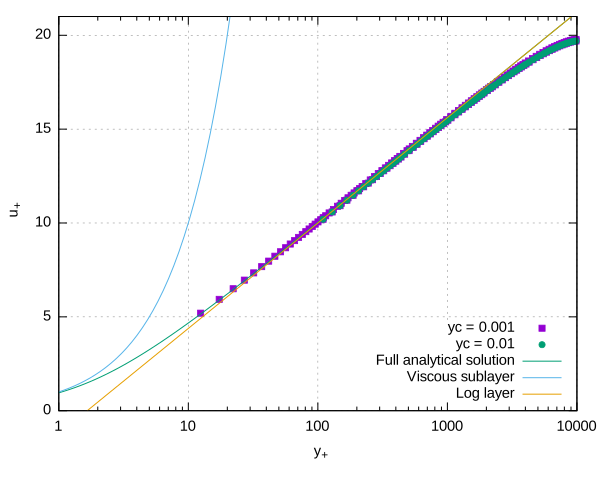
To highlight the small difference in the center of the channel (which is not described by the analytical solution) we remove the logscale and add the numerical result obtained when also resolving the viscous sublayer.
unset logscale x
plot '../loglayer/log' u 1:2 w l t 'Full numerical solution', \
     'log' index 'yc = 0.001' u 1:2 w l t 'yc = 0.001', \
     'log' index 'yc = 0.01' u 1:2 w l t 'yc = 0.01'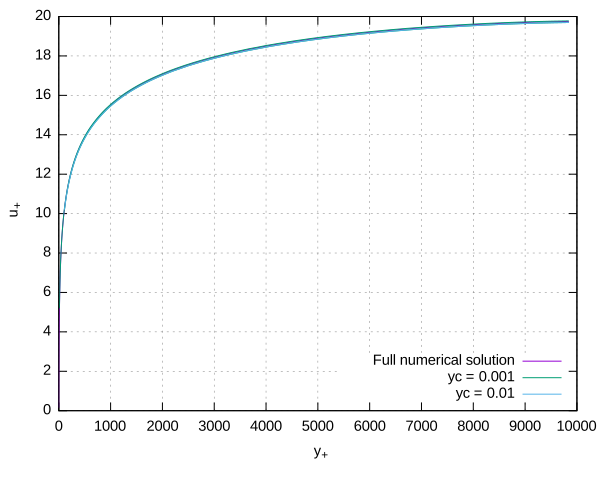
We can also check that the local friction velocity converges toward the “global” analytical friction velocity u_\star = \sqrt{GW} = 1.
set xlabel 'Time'
set ylabel 'u_*'
plot 'out' index 'yc = 0.001' u 1:5 w l t 'yc = 0.001', \
     'out' index 'yc = 0.01' u 1:5 w l t 'yc = 0.01'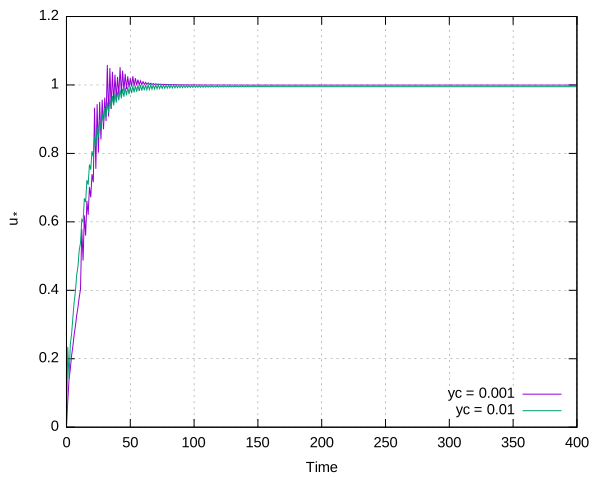
The distribution of mesh size across the channel illustrates the large gains obtained when avoiding the resolution of the viscous sublayer.
set xlabel 'y_+'
set ylabel '\Delta_+'
set logscale
set key top left
plot '../loglayer/log' u 1:3 w l t 'Full numerical solution', \
     'log' index 'yc = 0.001' u 1:3 w l t 'yc = 0.001', \
     'log' index 'yc = 0.01' u 1:3 w l lw 2 t 'yc = 0.01'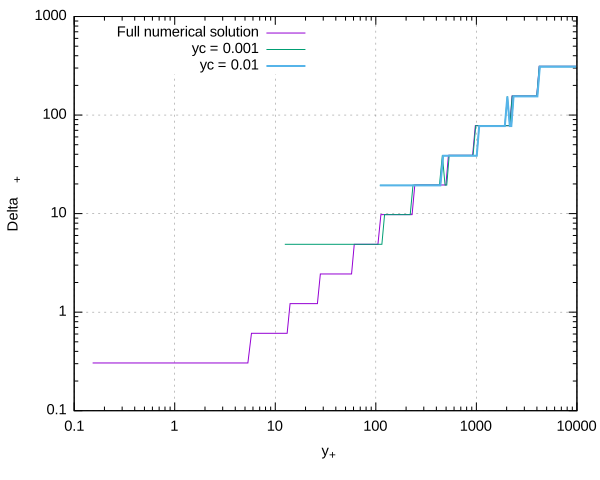
The convergence of the multigrid diffusion solver is also much faster when the large gradients in the viscous sublayer are avoided.
reset
set ylabel '# of multigrid iterations'
set xlabel 'Time'
plot '../loglayer/out' u 1:2 w l t 'Full numerical solution', \
     'out' index 'yc = 0.001' u 1:2 w l t 'yc = 0.001', \
     'out' index 'yc = 0.01' u 1:2 w l lw 2 t 'yc = 0.01'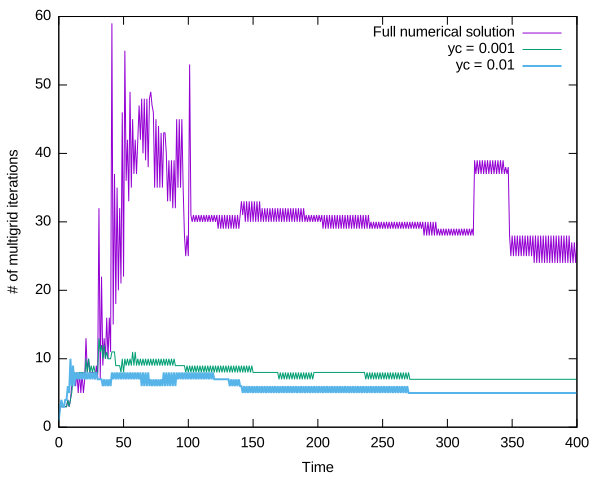
All this results in large gains in runtimes.
set ylabel 'Runtime (seconds)'
set xlabel 'Time'
set logscale y
set yrange [1e-4:]
plot '../loglayer/out' u 1:3 w l t 'Full numerical solution', \
     'out' index 'yc = 0.001' u 1:3 w l t 'yc = 0.001', \
     'out' index 'yc = 0.01' u 1:3 w l lw 2 t 'yc = 0.01'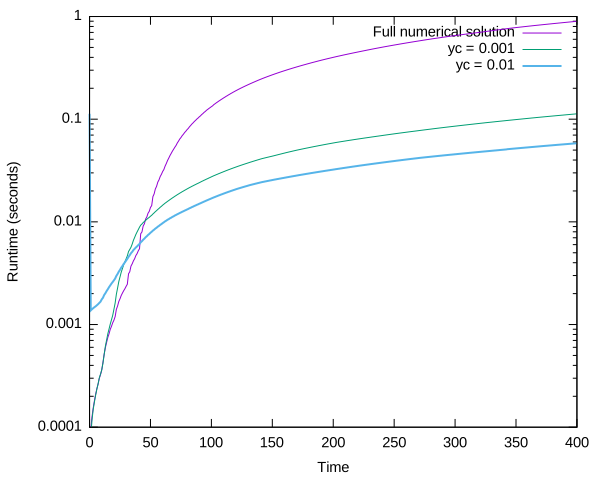
See also
References
| [lagree2026] |
Pierre-Yves Lagrée. Équations de Saint Venant et application aux mouvements de fonds érodables. “MU4MEF04 - Ondes et Écoulements en milieu naturel”, M1 SU, 2026. [ .pdf ] |