src/examples/loglayer.c
Viscous sublayer and log layer for turbulent flow in a channel
We consider a channel bounded by a no-slip wall on the left and a “slip wall” (i.e. a symmetry plane) on the right.
The flow is assumed to be fully turbulent and the time-averaged velocity is uniform along the flow direction and parallel to the walls.
We follow Boussinesq’s hypothesis that a “turbulent viscosity” exists so that the equations of motion (i.e. “Reynolds-averaged Navier-Stokes”) reduce to \partial_x(D\partial_x U) + G = 0 with D the sum of the fluid’s viscosity \nu and a turbulent viscosity \nu_t and G the driving acceleration.
This is a one-dimensional diffusion problem which can be solved on adaptive 1D grid (a bi-tree).
#include "grid/bitree.h"
#include "run.h"
#include "diffusion.h"
The parameters are the acceleration G and the fluid viscosity \nu. Note that we need a small enough value of the viscosity to get a separation of scales sufficient to capture both the viscous sublayer and the log layer. \kappa is the von Karman constant.
const double G = 1., nu = 1e-4;
const double kappa = 0.41 [0];
The numerical parameters are the minimum and maximum level of refinement. We need a large range of scales i.e. 2^{15} \approx O(10^4) to capture both the viscous sublayer and the log layer.
const int minlevel = 5, maxlevel = 15;The timestep cannot be too large. The tolerance controls the accuracy of the implicit diffusion solution. The initial mesh has 2^\text{minlevel} grid points.
int main() {
  DT = 1 [0,1];
  N = 1 << minlevel;
  run();
}
The only unknown is the velocity U, with the a Dirichlet zero boundary condition on the left and the default Neumann zero condition on the right.
scalar U[];
U[left] = dirichlet(0);
Time integration
In this event we solve the diffusion equation \partial_t U = \partial_x(D\partial_x U) + G
mgstats mg;

event integration (i++)
{
The timestep is computed taking account events if necessary and with
a maximum value bounded by DT.
dt = dtnext (DT);Field a is just the acceleration.
  scalar a[];
  foreach()
    a[] = G;
To initialize the diffusion coefficient D, we need a model for the turbulent viscosity \nu_t. We use Prandtl’s “mixing length” model which assumes that an important characteristic length of the flow is the distance to the boundary. The mixing length l is then defined as \kappa x and the turbulent viscosity is \nu_t = l^2 |\partial_x U| The diffusion coefficient is the sum of the fluid and the turbulent viscosity.
  face vector D[];
  foreach_face(x) {
    double l = kappa*x;
    double nu_t = sq(l)*fabs (U[] - U[-1])/Delta;
    D.x[] = nu + nu_t;
  }
  mg = diffusion (U, dt, D, r = a);
}
Mesh adaptation
We do not adapt at every timestep to minimize adaptation noise.
event adapt (i += 10)
  adapt_wavelet ({U}, {1e-2}, maxlevel, minlevel);
Convergence
400 timesteps are necessary/sufficient to reach a stationary solution.
Results
We output the final velocity profile. The characteristic “friction velocity” is u_\star = \sqrt{GL_0} where L_0 is the channel width. A characteristic length scale of the viscous sublayer is y_\star = \nu/u_\star.
event profile (t = end) {
  fprintf (stderr, "\n");
  const double u_star = sqrt(G*L0), y_star = nu/u_star;
  foreach (serial)
    fprintf (stderr, "%g %g %g %d\n", x/y_star, U[]/u_star, Delta/y_star, level);
}
We can then compare the numerical solution with the analytical solution (see p. 34 of Lagrée, 2026).
set xlabel 'y_+'
set ylabel 'u_+'
kappa = 0.41
set logscale x
u_plus(y) = (1./y - sqrt(4.*(y*kappa)**2 + 1.)/y + 2.*kappa*asinh(2.*y*kappa))/(2.*kappa**2)
u_log(y) = 1./kappa*log(y) + (log(kappa) - 1 + log(4.))/kappa
set key bottom right
plot [:][0:21]'log' u 1:2 pt 7 t 'Numerical', \
     u_plus(x) t 'Full analytical solution' lw 2, \
     x t 'Viscous sublayer', \
     u_log(x) t 'Log layer'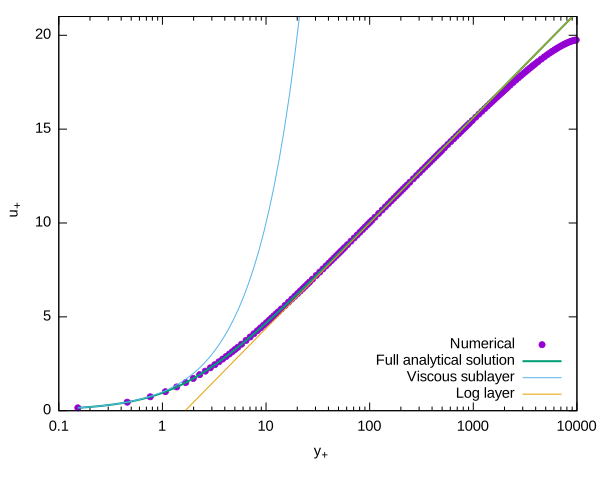
Although the mesh adaptation is not very visible on the graph above, it is indeed important as illustrated below.
set ylabel '\Delta_+'
set logscale y
plot 'log' u 1:3 w l t ''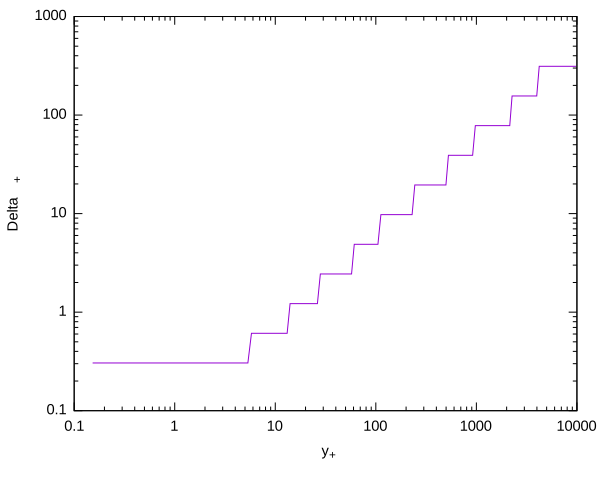
See also
References
| [lagree2026] |
Pierre-Yves Lagrée. Équations de Saint Venant et application aux mouvements de fonds érodables. “MU4MEF04 - Ondes et Écoulements en milieu naturel”, M1 SU, 2026. [ .pdf ] |