src/examples/held-suarez-postproc.c
Post-processing for the Held-Suarez example
This example illustrates how to post-process the outputs of the Held & Suarez example to obtain classical diagnostics.
The time-averaged zonal velocity compares closely with Figure 2 of Held & Suarez, 1994. The easterly trade winds at the surface reach -8 m/s at \pm 15 degrees latitude, the mid-latitude westerlies 8 m/s at \pm 45 degrees. The jet streams in the upper troposphere reach 30 m/s.
set term png enhanced size 1280,800 font ",18"
set pm3d map interpolate 4,4 at b
unset key
# jet colormap
set palette defined ( 0 0 0 0.5647, 0.125 0 0.05882 1, 0.25 0 0.5647 1,	\
0.375 0.05882 1 0.9333, 0.5 0.5647 1 0.4392, 0.625 1 0.9333 0, 0.75 1 0.4392 0,	\
0.875 0.9333 0 0, 1 0.498 0 0 )
set contour base
set cntrparam levels incremental -12,4,32
set cbrange [-12:32]
set cntrlabel onecolor
set cntrlabel font ",14"
set xtics -90,30,90
set xlabel 'Latitude'
set ylabel 'Altitude'
set output 'zonal_velocity.png'
splot [-90:90][0:1]'out' index 'zonal velocity' u 1:($2/19.):3 lt 3 lc rgb "#000000", \
     '' index 'zonal velocity' u 1:($2/19.):3 w labels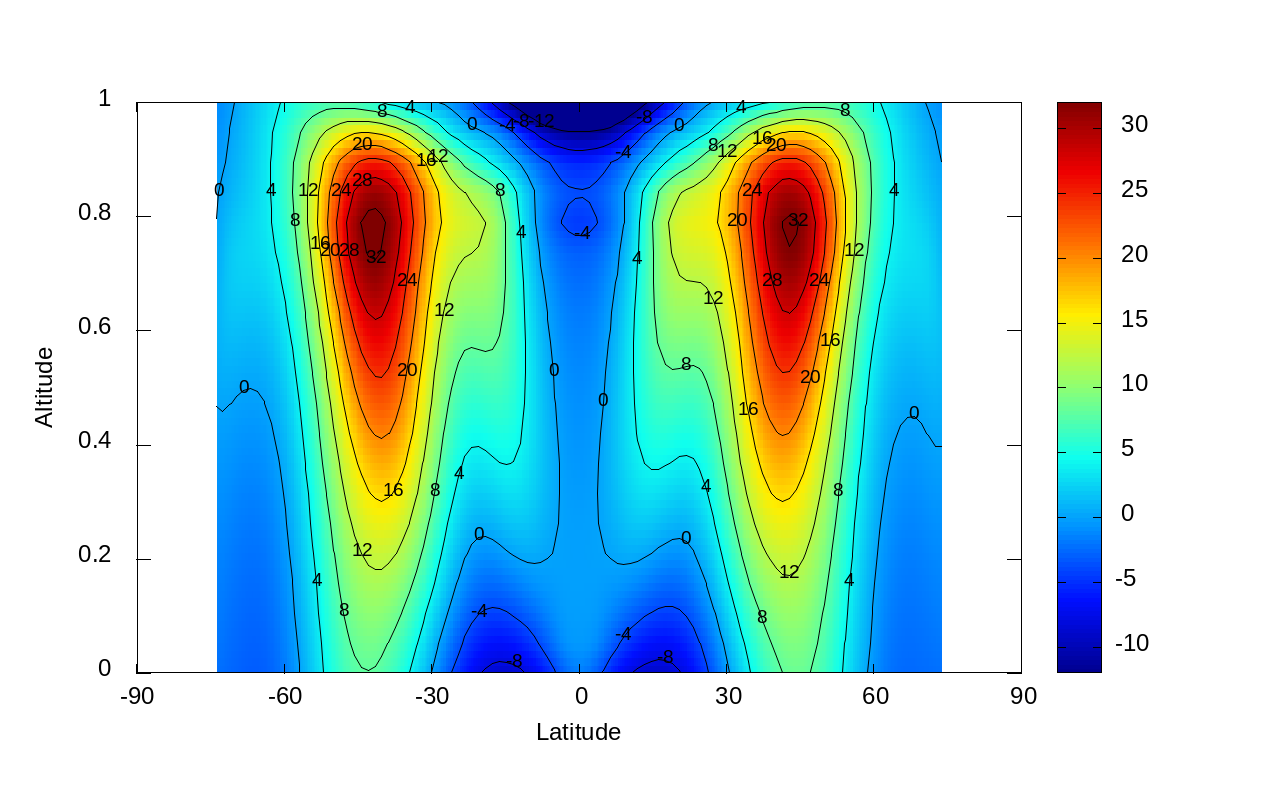
The variance of the zonal temperature also compares well with Figure 3 of Held & Suarez, 1994.
Note that the early calculations done with Gerris and reported in Popinet, 2012, were correct but that the graph presented in slide 27 (left) is the potential temperature, not the temperature, which explains the difference in the stratosphere compared to the graph on slide 27 (right) from Ringler et al, 2000.
set cbrange [*:*]
set cntrparam levels incremental 5,5,40
set cbrange [0:40]
nl = 20
Kappa = 2./7. # R/cp
P0 = 101300.
Ps(z) = P0 - (z)
PI(i) = (Ps(P0*(i + 0.5)/nl)/P0)**Kappa
set output 'zonal_variance.png'
splot [-90:90][0:1]'out' index 'zonal variance' u 1:($2/19.):($3*PI($2)**2) lt 3 lc rgb "#000000", \
     '' index 'zonal variance' u 1:($2/19.):($3*PI($2)**2) w labels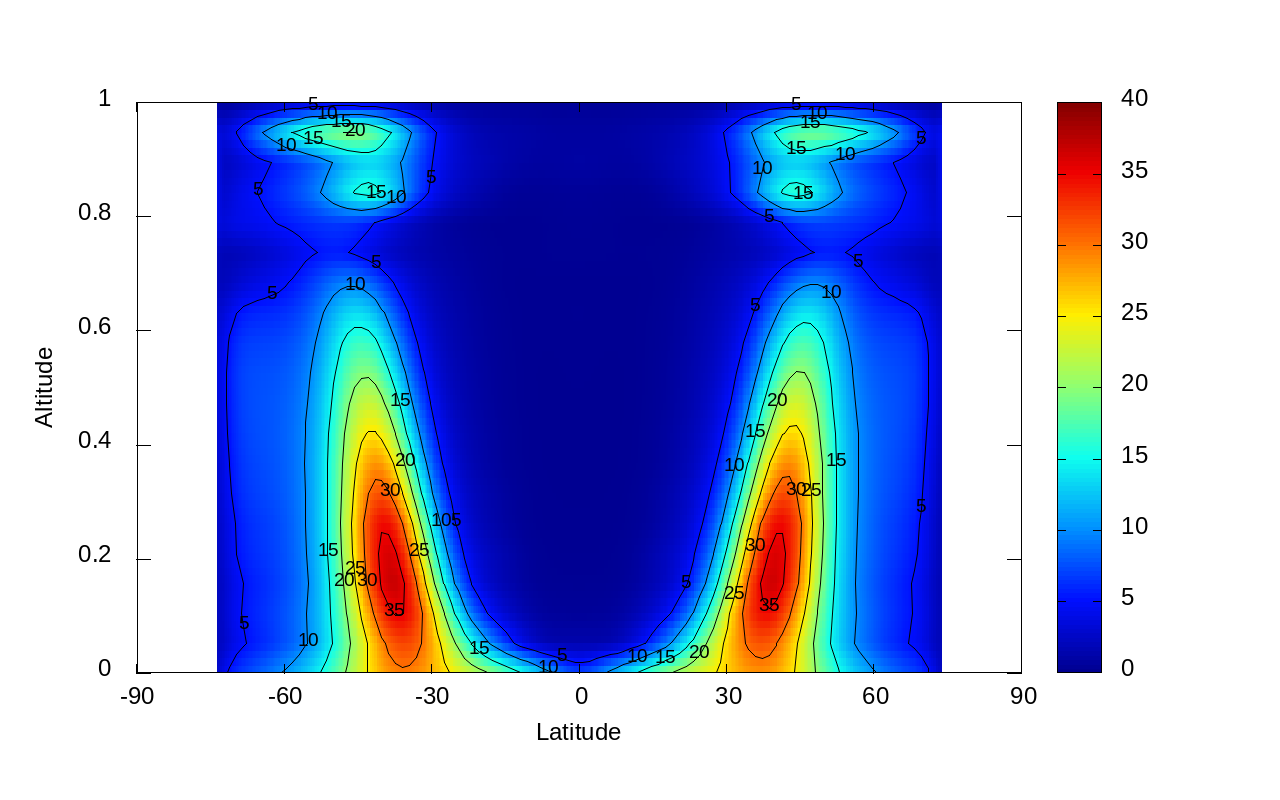
So do the time-averaged zonal temperature and zonal potential temperature.
set cbrange [*:*]
set cntrparam levels incremental 190,5,305
set cbrange [190:305]
set output 'zonal_temperature.png'
splot [-90:90][0:1]'out' index 'zonal temperature' u 1:($2/19.):($3*PI($2)) lt 3 lc rgb "#000000", \
     '' index 'zonal temperature' u 1:($2/19.):($3*PI($2)) w labels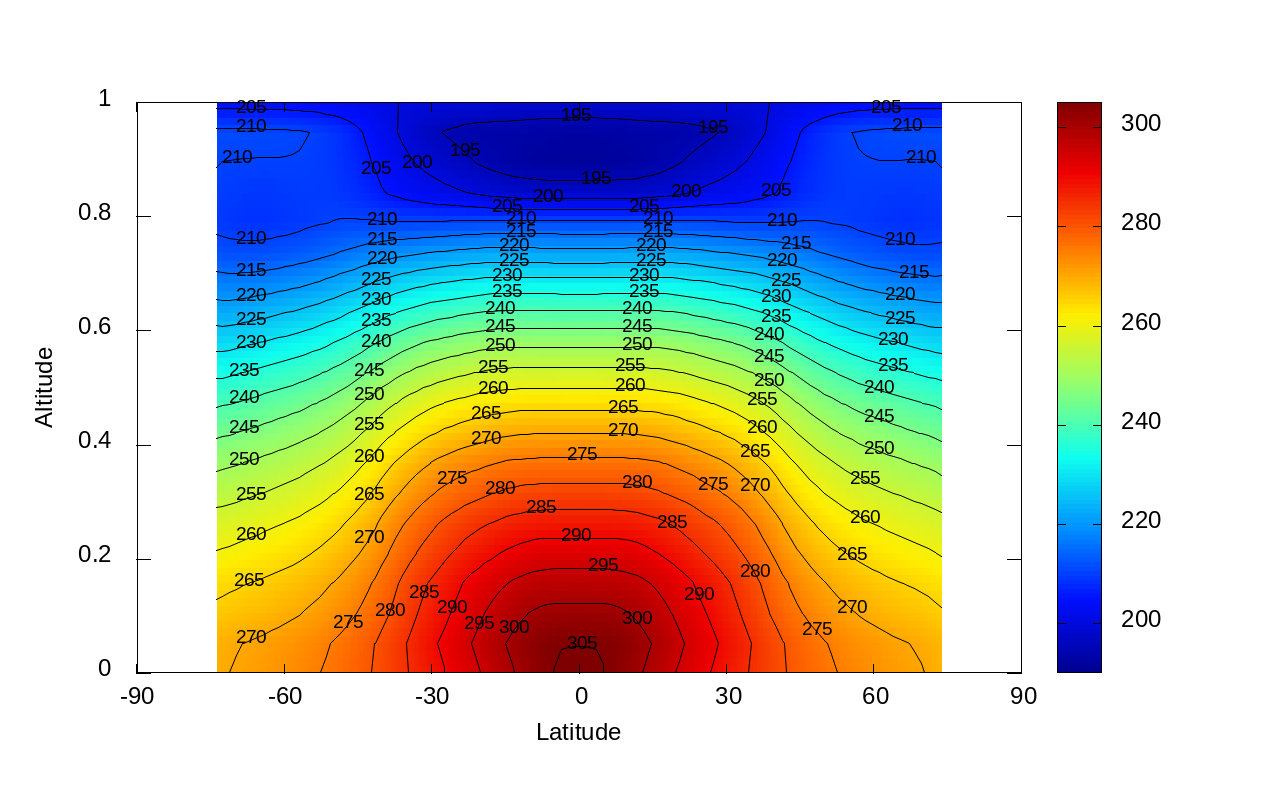
set term svg enhanced size 640,400 font ",9"
set cntrparam levels incremental 270,5,350
set cbrange [*:*]
unset surface
unset colorbox
set cntrlabel font ",7"
splot [-90:90][0:1]'out' index 'zonal temperature' u 1:($2/19.):3 lt 3 lc rgb "#000000", \
     '' index 'zonal temperature' u 1:($2/19.):3 w labels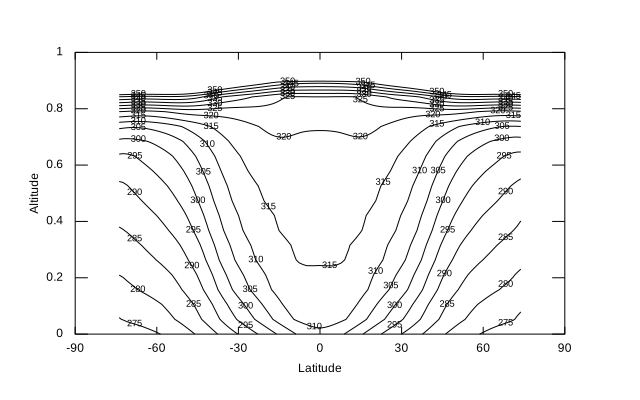
#include "grid/multigrid.h"
#include "utils.h"
This macro computes the zonal average of expr at level
l.
macro zonal_average (double expr, int l)
{{
  const double maxlat = 75;
  double delta = L0/N;
  for (double y = - 90 + delta/2.; y <= maxlat; y += delta)
    if (y > - maxlat) {
      double sum = 0.;
      coord p;
      coord box[2] = {{X0, y - delta/2.}, {X0 + L0, y + delta/2.}};
      coord n = {N, 1};
      foreach_region (p, box, n, reduction(+:sum))
        sum += expr;
      printf ("%g %d %g\n", y, l, sum/n.x);
    }
}}

int main ()
{
  if (!restore (file = "../held-suarez/dump", list = all)) {
    fprintf (stderr, "could not restore\n");
    exit (1);
  }
  restriction (all);
  fields_stats();

  printf ("# zonal velocity\n");
  for (int l = 0; l < 20; l++) {
    char name[80] = "mu";
    if (l > 0)
      sprintf (name, "mu%d", l);
    scalar mu = lookup_field (name);
    zonal_average (mu[], l);
    printf ("\n");
  }

  printf ("\n# zonal variance\n");
  for (int l = 0; l < 20; l++) {
    char name[80] = "vtheta";
    if (l > 0)
      sprintf (name, "vtheta%d", l);
    scalar vtheta = lookup_field (name);
    zonal_average (vtheta[], l);
    printf ("\n");
  }

  printf ("\n# zonal temperature\n");
  for (int l = 0; l < 20; l++) {
    char name[80] = "mtheta";
    if (l > 0)
      sprintf (name, "mtheta%d", l);
    scalar mtheta = lookup_field (name);
    zonal_average (mtheta[], l);
    printf ("\n");
  }
}
Todo
- The “vertically averaged zonal spectra of the eddy variance of zonal wind” (Figure 4 of H&S, 1994) would be nice too.
References
| [popinet2012] |
S. Popinet. Quadtree-adaptive global atmospheric modelling on parallel systems (invited talk). In Weather and Climate Prediction on Next Generation Supercomputers, Exeter, UK, 22-25 October, 2012. [ .pdf ] |