sandbox/yixian/granular_bottom_dynamicNGF.c
Flow in a Sandglass / Hourglass / Silo with a bottom orifice
We propose an implementation of the dynamic non-local granular fluidity(dynamic NGF) model proposed by Kamrin and Henann(2015) for the flow in a silo with a bottom orifice.
Code
Includes and definitions
#include "grid/multigrid.h"
#include "navier-stokes/centered.h"
#include "vof.h"
#include "poisson.h"
#include "diffusion.h"
#define LDOMAIN 1.

double  H0,R0,D,W,tmax;
double zetaA;      // nonlocal amplitude A
#define RHOF 1e-4
#define mug  1e-5
#define LEVEL 6

char s[80];
FILE * fpf,*fwq;
scalar f[];
scalar * interfaces = {f};
face vector alphav[];
face vector muv[];
scalar rhov[];
scalar duxx[],duxy[],duyx[],duyy[],dpdx[],dpdy[];

/* Nonlocal fields and params*/
scalar eta[];
scalar zeta_loc[];   //
face vector alphaf[]; //

scalar muIloc[];    /* local mu(I) */
scalar muI[];
scalar muIold[];   //  μ^n

scalar gloc[];      /* local fluidity */
scalar gnonloc[];   /* nonlocal fluidity (solution) */
scalar gold[];     //  g^n

double mu_s     = 0.4;
double mu_2     = 0.68;      //
double I0       = 0.4;       //
double t0_g     = 0.001;      //
double rhos     = 1.;        // density of granular
double t_switch = 0.1;

/* Boundary conditions */
p[top] = dirichlet(0);
pf[top] = dirichlet(0);
u.n[top] = neumann(0);
u.t[bottom] =  fabs(x-LDOMAIN/2)<= W/2 ? neumann(0):  dirichlet(0);
u.n[bottom] =  fabs(x-LDOMAIN/2)<= W/2 ? neumann(0):  dirichlet(0);
p[bottom]   =  fabs(x-LDOMAIN/2)<= W/2 ? dirichlet(0): neumann(0);
pf[bottom]   =  fabs(x-LDOMAIN/2)<= W/2 ? dirichlet(0): neumann(0);
u.n[right] = dirichlet(0);
u.n[left] = dirichlet(0);
u.t[right] = dirichlet(0);
u.t[left] = dirichlet(0);


// ==== boundary condition for g  ====
gnonloc[left]  = dirichlet(0);
gnonloc[right] = dirichlet(0);
gnonloc[top] = neumann(0);
gnonloc[bottom] = fabs(x-LDOMAIN/2)<= W/2 ? neumann(0): dirichlet(0);

int main(int argc, char ** argv) {

    disable_fpe (FE_DIVBYZERO|FE_INVALID);
    L0 = LDOMAIN;
    N = 1 << LEVEL;
    TOLERANCE = 1e-3;
    H0 = 0.9;
    R0 = 20.000;
    const face vector g[] = {0.,-1.,0};
    a = g;
    alpha = alphav;
    mu = muv;
    rho = rhov;
    DT = 0.001;
    tmax = 4.;
    W = 0.25;
    zetaA = 0.5;
    D = 0.04375;
    fpf = fopen ("interface.txt", "w");
    run();
    fclose (fpf);
    fprintf (stdout,"\n");

    return 0;
}

/* initial heap, a rectangle */
event init (t = 0) {
    scalar phi[];
    foreach_vertex()
        phi[] = min(H0 - y, R0 - x);
    fractions (phi, f);
    foreach(){
        p[] = (fabs(x-LDOMAIN/2)<= W/2 && fabs(y)<= .1) ?  0 : max(H0 - y,0) ;
    }
}

#define rho(f) ((f) + RHOF*(1. - (f)))
We use the full dynamic form of the NGF equation:
t_0\dot{g} = A^{2}d^{2}\nabla^{2}g - \Delta{\mu}\left(\frac{\mu_{s} - \mu}{\mu_{2} - \mu}\right)g - b\sqrt{\frac{\rho_{s}d^{2}}{p}}\mu g^{2}.
In this equation, t_0 is a relaxation time scale, and b = \Delta\mu / I_0 is a material constant. Following Dunatunga and Kamrin(2022), we employ an operator-splitting scheme via an intermediate variable g^*:
\frac{g^* - g^n}{\Delta t} = \frac{1}{t_0} A^2 d^2 \nabla^2 g^*_{i,j},
\frac{g^{n + 1} - g^*}{\Delta t} = \frac{1}{t_0}\left(-\Delta \mu \left(\frac{\mu_s - \mu^{n+1}_\mathrm{loc}}{\mu_2 - \mu^{n+1}_\mathrm{loc}}\right)g^{n + 1} - \frac{\Delta\mu}{I_0}\sqrt{\frac{\rho_s d^2}{p^{n + 1}}}\mu^n g^n g^{n + 1}\right).
In the diffusion step, g^* is solved implicitly. In the reaction step, we use the local friction coefficient \mu_{\mathrm{loc}}^{n+1}, whereas employs the global \mu^{n+1}.
event properties (i++) {
    trash ({alphav});
    foreach()
        eta[] = mug;

    // ===== 0. save g^n and μ^n =====
    foreach () {
        gold[]   = gnonloc[];// g^n
        muIold[] = muIloc[]; // μ^n
    }
    // ===== 1. Solve:μ^{n+1} and g_loc =====
    foreach () {
      gloc[]     = 0.;
      muIloc[]   = 0.;
      zeta_loc[] = 0.;

        if (p[] > 0. && f[] > 0.) {
            double D2 = 0.;
            foreach_dimension() {
                double dxx = u.x[1,0] - u.x[-1,0];
                double dxy = (u.x[0,1] - u.x[0,-1] + u.y[1,0] - u.y[-1,0]) / 2.;
                D2 += sq(dxx) + sq(dxy);
            }

            if (D2 > 0.) {
                D2 = sqrt(D2)/(2.*Delta);        //
                double sD2 = sqrt(2.)*D2;        // shear rate gammatot
                double In  = sD2*D/sqrt(p[]);    // I

                double mu_loc = mu_s + (mu_2 - mu_s)*In/(I0 + In);
                muIloc[] = mu_loc;

                gloc[]   = sD2/(mu_loc);     // g_loc = gammatot/μ_loc

                double xi  = zetaA * D;
                zeta_loc[] = xi;

            }
        }
        else {
            gloc[]     = 0.;
            muIloc[]   = 0.;
            muI[] = 0.;
            zeta_loc[] = 0.;
        }
    }
    boundary ({gloc, muIloc, zeta_loc});

    // ===== 2. t < t_switch:Local rheology =====
    if (t < t_switch) {
        foreach() {
          if (p[] > 0. && f[] > 0.) {
            double D2 = 0.;
            foreach_dimension() {
              double dxx = u.x[1,0] - u.x[-1,0];
              double dxy = (u.x[0,1] - u.x[0,-1] + u.y[1,0] - u.y[-1,0]) / 2.;
              D2 += sq(dxx) + sq(dxy);
            }

            if (D2 > 0.) {
              D2 = sqrt(D2)/(2.*Delta);
              double sD2 = sqrt(2.)*D2;
              double mu_loc = muIloc[];

              double etamin = sqrt(D*D*D);
              double eta_loc = (mu_loc * p[]) / sD2;
              eta_loc = max(eta_loc, etamin);
              eta_loc = min(eta_loc, 100.);
              eta[]   = eta_loc;

              gnonloc[] = gloc[];
              muI[]     = mu_loc;
            } else {
              eta[]     = 100.;
              gnonloc[] = 0.;
              muI[]     = 0.;
            }
          }
          else {
            eta[]     = mug;
            gnonloc[] = 0.;
            muI[]     = 0.;
          }
        }
        boundary ({eta, gnonloc, muI});
      }
    // ============ 3. t >= t_switch:Dynamic NGF ============
    if (t >= t_switch) {
        foreach_face(x) {
            double zf = 0.5*(zeta_loc[] + zeta_loc[-1,0]);
            alphaf.x[] = sq(zf);
        }
        foreach_face(y) {
            double zg = 0.5*(zeta_loc[] + zeta_loc[0,-1]);
            alphaf.y[] = sq(zg);
        }
        boundary ((scalar *){alphaf});

        foreach()
            gnonloc[] = gloc[];
        boundary ({gnonloc});


        // 3.1 solve: g* - dt ∇·(ξ² ∇g*) = g^n
        mgstats mg_g = diffusion (gnonloc, dt/t0_g, alphaf);
        if (mg_g.i > 0 && mg_g.resa > 0.)
            fprintf (stderr,
                     "#   gnonloc diffusion: i=%d resa=%g resb=%g\n",
                     mg_g.i, mg_g.resa, mg_g.resb);


        boundary ({gnonloc});


        // --- 3.2 solve g^{n+1} ---
        foreach() {
            if (p[] > 0. && f[] > 0.) {

                double D2 = 0.;
                foreach_dimension() {
                    double dxx = u.x[1,0] - u.x[-1,0];
                    double dxy = (u.x[0,1] - u.x[0,-1] + u.y[1,0] - u.y[-1,0]) / 2.;
                    D2 += sq(dxx) + sq(dxy);
                }

                if (D2 > 0.) {
                    D2 = sqrt(D2)/(2.*Delta);
                    double sD2 = sqrt(2.)*D2;

                    double mu_new  = muIloc[];    // μ^{n+1}
                    double mu_old  = muIold[];   // μ^n
                    double g_old  = gold[];     // g^n
                    double gstar   = gnonloc[];   // g*

                    // splitting scheme α^{n+1} = Δμ (μ_s - μ^{n+1})/(μ_2 - μ^{n+1})
                    double alpha = (mu_2-mu_s)*(mu_s - mu_new)/
                    (mu_2 - mu_new);

                    // β^{n+1} = (Δμ/I0) sqrt(ρ_s d^2 / p^{n+1}) μ^n g^n
                    double beta = ((mu_2-mu_s)/I0)*
                        sqrt(rhos*D*D/p[])*mu_old*g_old;

                    double denom = 1. + (dt/t0_g)*(alpha + beta);
                    double gnew = gstar/denom;
                    gnonloc[] = gnew;          //  g^{n+1}
                    double mu_eff = sD2/(gnew);
                    muI[] = mu_eff;

                    double etamin = sqrt(D*D*D);
                    double eta_nonloc = (mu_eff * p[]) / sD2;
                    eta_nonloc = max(eta_nonloc, etamin);
                    eta_nonloc = min(eta_nonloc, 100.);
                    eta[] = eta_nonloc;

                } else {
                    eta[]     = 100.;
                    gnonloc[] = 0.;
                    muI[]     = 0.;
                }
            }
            else {
                eta[]     = mug;
                gnonloc[] = 0.;
                muI[]     = 0.;
            }
        }
        boundary ({gnonloc, eta, muI});
    }

    scalar fa[];
    foreach()
        fa[] = (4.*f[] +
                2.*(f[-1,0] + f[1,0] + f[0,-1] + f[0,1]) +
                f[1,1] + f[-1,1] + f[1,-1] + f[-1,-1]) / 16.;
    boundary ({fa});

    foreach_face() {
        double fm = (fa[] + fa[-1,0]) / 2.;
        muv.x[]   = (fm * (eta[] + eta[-1,0]) / 2. + (1. - fm) * mug);
        alphav.x[] = 1.0 / rho(fm);
    }
    foreach()
        rhov[] = rho(fa[]);
    boundary ({muv, alphav, rhov});
    foreach(){
        duxy[] = (u.x[0,1] - u.x[0,-1])/2./Delta + (u.y[1,0] - u.y[-1,0])/2./Delta ;
        duyx[] = (u.y[1,0] - u.y[-1,0])/2./Delta + (u.x[0,1] - u.x[0,-1])/2./Delta ;
        duxx[] = 2 * (u.x[1,0] - u.x[-1,0])/2./Delta ;
        duyy[] = 2 * (u.y[0,1] - u.y[0,-1])/2./Delta;
        dpdx[] = (p[1,0] - p[-1,0])/2./Delta;
        dpdy[] = (p[0,1] - p[0,-1])/2./Delta;
    }
}

/* convergence outputs */
void mg_print (mgstats mg)
{
    if (mg.i > 0 && mg.resa > 0.)
        fprintf (stderr, "#   %d %g %g %g\n", mg.i, mg.resb, mg.resa,
                 exp (log (mg.resb/mg.resa)/mg.i));
}

event logfile (i++) {
    stats s = statsf (f);
    fprintf (stderr, "%g %d %g %g %g %g\n", t, i, dt, s.sum, s.min, s.max - 1.);
    mg_print (mgp);
    mg_print (mgpf);
    mg_print (mgu);
    fflush (stderr);
}


/* output including gnonloc for diagnostics */
event interface (t = 2 ; t+=1. ; t<= 4.) {
#if dimension == 2
  output_facets (f, fpf);
#endif
  char s[80];
  sprintf (s, "field-%g.txt", t);
  FILE * fp = fopen (s, "w");
  output_field ({f,p,u,uf,pf,muIloc,muI,gloc,gnonloc,eta,duxx,duxy,duyx,duyy,dpdx,dpdy}, fp, linear = true);
  fclose (fp);
}

/* debit: use explicit dx */
event debit (t += 0.05; t <= tmax ) {
    static double Vold,V=1,Qinst=0;
    Vold=V;
    V=0;
    double dx = L0 / N;
    foreach()
        V = V + f[] * dx * dx;
    Qinst = -(V-Vold)/0.05;
    if(t>=.1) fprintf (stdout,"%lf %lf %lf \n",t,V,Qinst);
    fflush (stdout);
}
to run
qcc  -g -O2 -o granular_bottom_dynamicNGF granular_bottom_dynamicNGF.c -lm
./granular_bottom_dynamicNGF > vol
Plots
Plot of vertical velocity at time 2
 reset
 set pm3d map
 set pm3d; set palette rgbformulae 22,13,-31;
 splot 'field-2.txt' u 1:2:(abs($6)*$3) with pm3d notitle
 set label "Vy" at graph 0.45, 0.85 font ",24" front
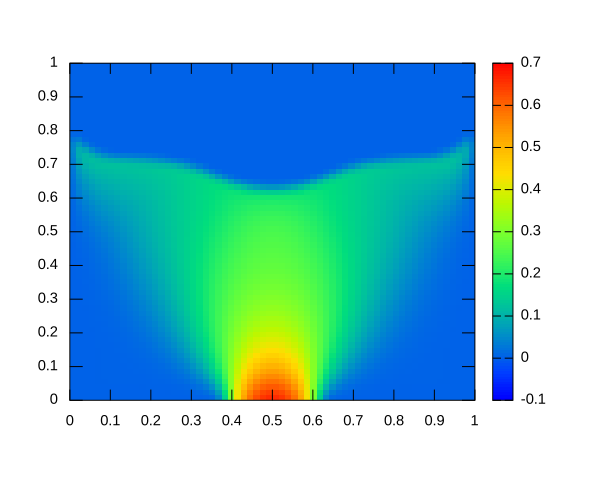
set terminal postscript color enhanced set output “t2vy.eps” replot
Plot of pressure at time 2
 reset
 set pm3d map
 set pm3d; set palette rgbformulae 22,13,-31;
 splot 'field-2.txt' u 1:2:(abs($4)**$3) with pm3d notitle
 set label "pressure" at graph 0.45, 0.85 font ",24" front
 set terminal postscript color enhanced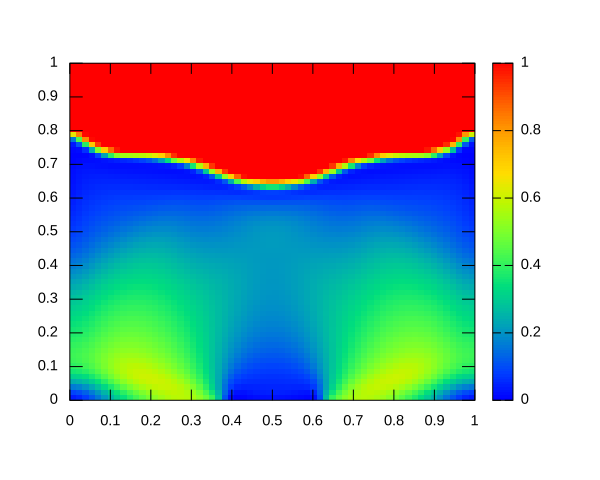
set output “t2p.eps” replot
Plot of viscosity at time 2
 reset
 set cbrange [0:2]
 set pm3d map
 set pm3d; set palette rgbformulae 22,13,-31;
 set label "Viscosity" at graph 0.45, 0.85 font ",24" front
 splot 'field-2.txt' u 1:2:(abs($14)**$3) with pm3d notitle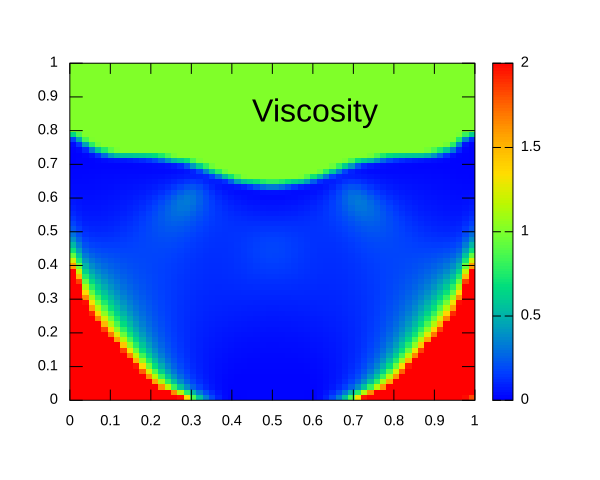
set terminal postscript color enhanced set output “t2eta.eps” replot
Links
https://basilisk.fr/sandbox/yixian/granular_bottom_NGF.c
https://basilisk.fr/sandbox/yixian/granular_bottom_constantNGF.c
https://basilisk.fr/sandbox/yixian/granular_bottom_dynamicNGF.c
https://basilisk.fr/sandbox/yixian/granular_bottom_linearisedconstantNGF.c
https://basilisk.fr/sandbox/yixian/granular_bottom_linearisedNGF.c
https://basilisk.fr/sandbox/yixian/granular_bottom_Local.c
https://basilisk.fr/sandbox/yixian/granular_bottom_muItheta.c
https://basilisk.fr/sandbox/yixian/granular_bottom_Igradient.c
Bibliography
Y. Zhou PhD https://theses.fr/2016AIXM4731
L. Staron, P.-Y. Lagrée, & S. Popinet (2014)
“Continuum simulation of the discharge of the granular silo, A validation test for the μ(I) visco-plastic flow law”
Eur. Phys. J. E (2014) 37: 5 DOI 10.1140/epje/i2014-14005-6L. Staron, P.-Y. Lagrée & S. Popinet (2012)
“The granular silo as a continuum plastic flow: the hour-glass vs the clepsydra”
Phys. Fluids 24, 103301 (2012); doi: 10.1063/1.4757390Kamrin, K. and Koval, G. (2012). Nonlocal constitutive relation for steady granular flow. Phys. Rev. Lett., 108:178301.
Kamrin, K. and Henann, D. L. (2015). Nonlocal modeling of granular flows down inclines. Soft Matter, 11:179–185.
Dunatunga, S. and Kamrin, K. (2022). Modelling silo clogging with non-local granular rheology. J. Fluid Mech., 940:A14.