sandbox/rcaraccio/run/porous-cylinder.c
Wake forming behind a porous cylinder
This is a simulation of the flow past a porous cylinder testing the implementation of the Darcy-Forchheimer model in Basilisk. We consider a 2D domain with a cylinder of radius R0 placed at the symmetry axis. The flow is driven by a constant inflow velocity U0 at the left boundary. We set the fluid viscosity muG to achieve a specified Reynolds number. This test case is inspired by the work of Yu et al. (2011).
We run several cases varying the permeability of the porous medium, represented by the Darcy number Da. The wake length is measured as the point at which u.x along the centerline (y=0) becomes zero again after the cylinder.
Simulation parameters
int maxlevel = 9;         // Maximum refinement level
double Re = 20;           // Reynolds number
double R0 = 0.5;          // Cylinder radius
double U0 = 1.;           // Inflow velocity
double epsi0 = 0.7;       // Porosity
double side_length = 15.; // Domain length in terms of R0
double tend = 10.;        // End time

#include "navier-stokes/centered.h"
#include "two-phase.h"
#include "darcy.h"
#include "view.h"
#include "adapt_wavelet_leave_interface.h"
Boundary conditions
Boundary conditions are inlet on the left, outlet on the right, symmetry on top and on bottom.
u.n[left] = dirichlet (U0);
u.t[left] = dirichlet (0.);
p[left] = neumann (0.);
pf[left] = neumann (0.);

u.n[right] = neumann (0.);
u.t[right] = neumann (0.);
p[right] = dirichlet (0.);
pf[right] = dirichlet (0.);

scalar porosity[];
double rhoG = 1., muG;
Simulation setup
We declare the list of Darcy numbers to simulate.
double DaList[] = {1.00E-05, 5.00E-05, 1.00E-04, 5.00E-04, 1.00E-03, 2.50E-03, 5.00E-03};
unsigned int ii = 0; // Index of the current case

int main() {
We set the fluid properties based on the Reynolds number. For both phases, we want to use the gas properties.
  muG = R0*2*U0/Re;
  rho1 = rho2 = rhoG;
  mu1 = mu2 = muG;

  L0 = side_length*R0*2;
  origin (-L0/2, 0);
  init_grid (1 << maxlevel);
  f.tracers = {porosity};
We download the reference data from Yu et al. (2011) for comparison.
system ("wget -q https://raw.githubusercontent.com/Riccaraccio/basilisk-sandbox-rcaraccio/refs/heads/master/data/porouscylinder/yuData");We run the cases for each Darcy number in DaList.
  size_t n_cases = sizeof(DaList)/sizeof(DaList[0]);
  for (ii = 0; ii < n_cases; ii++) {
    Da = (coord) {DaList[ii], DaList[ii]};
    run();
  }
}
Initialization event
We initialize a cylinder of radius R0 at the center of the domain. Exploiting symmetry, we only simulate the upper half of the domain.
#define circle(x, y, R) (sq(R) - sq(x) - sq(y))
event init (i = 0) {
  fraction (f, circle(x, y, R0));
  foreach() {
    porosity[] = f[]*epsi0;
    u.x[] = U0;
  }
}
Stability and Adaptation events
To ensure numerical stability, we limit the CFL number to a maximum value.
const double max_cfl = 0.1;
event stability (i++) {
  if (CFL > max_cfl)
    CFL = max_cfl;
}

event adapt (i++) {
  adapt_wavelet_leave_interface ({u.x, u.y}, {f}, (double[]){1.e-3, 1.e-3}, maxlevel, 2, padding=2);
}
We avoid transport of the interface by setting the velocity to zero in the VOF event. After the interface advection, we restore the original velocity field.
face vector ufsave[];
event vof (i++) {
  foreach_face() {
    ufsave.x[] = uf.x[];
    uf.x[] = 0.;
  }
}

event tracer_diffusion (i++) {
  foreach_face()
    uf.x[] = ufsave.x[];
}
Embed implementation (commented out)
Here we use the embed method to represent the cylinder as a solid object. This is to obtain the wake length for comparison with the porous cylinder cases.
/*
#include "embed.h"
#include "navier-stokes/centered.h"
#include "view.h"
#include "adapt_wavelet_leave_interface.h"

u.n[left] = dirichlet (U0);
u.t[left] = dirichlet (0.);
p[left] = neumann (0.);

u.n[right] = neumann (0.);
u.t[right] = neumann (0.);
p[right] = dirichlet (0.);

u.n[embed] = fabs(y) > R0 ? neumann(0.) : dirichlet(0.);
u.t[embed] = fabs(y) > R0 ? neumann(0.) : dirichlet(0.);

face vector muv[];

int main() {
  mu = muv;

  L0 = side_length*R0*2;
  origin(-L0/2, 0);
  init_grid (1 << maxlevel);
  run();
}

#define circle(x, y, R) (sq(R) - sq(x) - sq(y))

event properties (i++){
  foreach_face()
    muv.x[] = fm.x[]*R0*2*U0/Re;
}

event init (i = 0) {
  mask (y > L0/2 ? top : none);
  solid (cs, fs, -circle(x, y, R0));
  foreach()
    u.x[] = cs[] > 1.- 1.e-10 ? U0 : 0;
}

event adapt (i++) {
  adapt_wavelet_leave_interface ({u.x, u.y}, {cs}, (double[]){1.e-3, 1.e-3}, maxlevel, 3, padding=1);
}
*/
Movie event
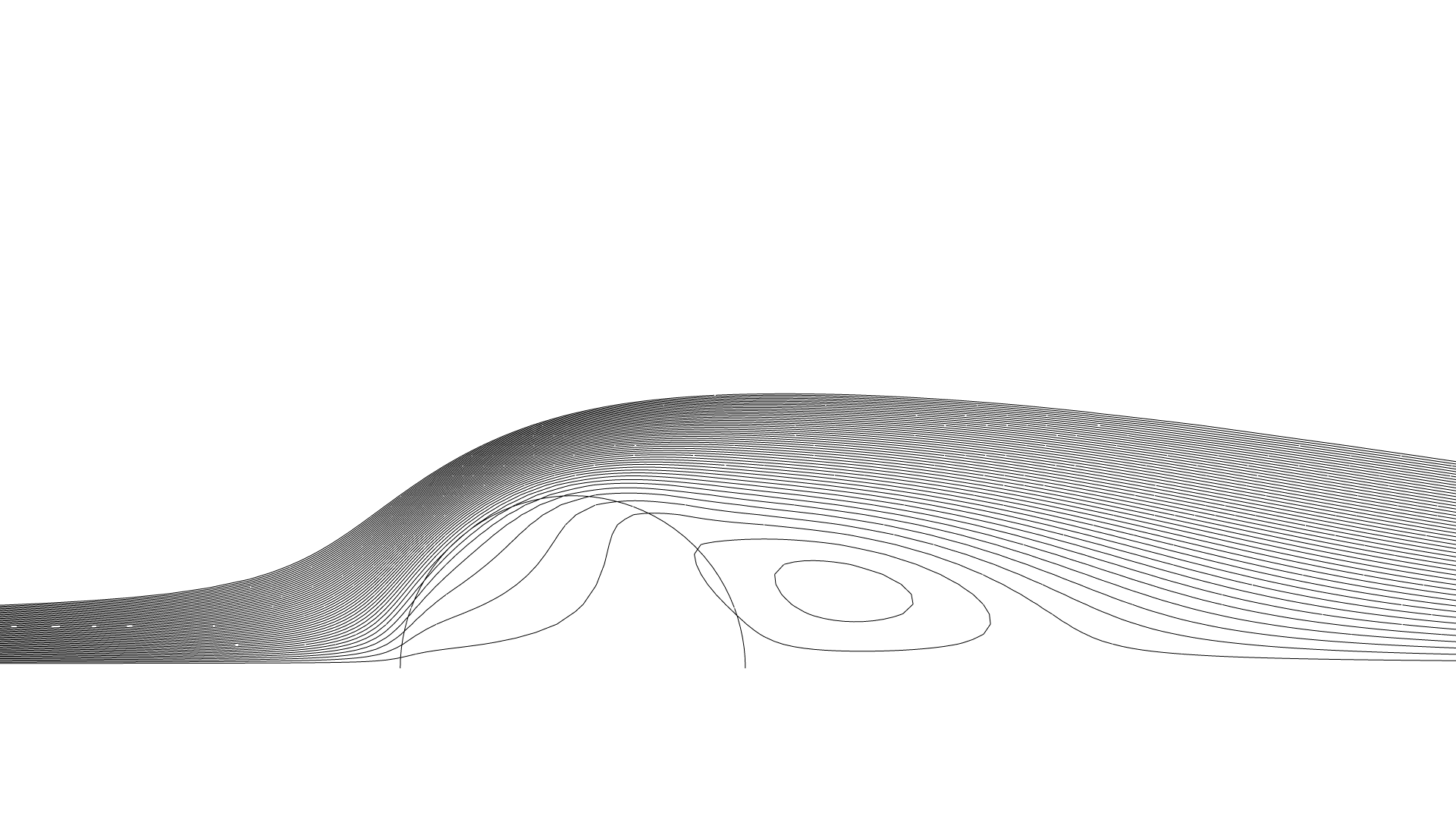
We visualize the streamlines developing around the cylinder for case 4.
scalar strline[], omega[];
strline[top] = dirichlet(0);
strline[bottom] = dirichlet(U0 * L0);
event movie (t = end) {
  if (ii == 4) {
    foreach ()
      omega[] = 0;

    vorticity(u, omega);

    poisson(strline, omega);
    boundary({strline});

    view(quat = {0.000, 0.000, 0.000, 1.000},
         fov = 30, near = 0.01, far = 1000,
         tx = -0.03, ty = -0.05, tz = -0.3,
         width = 1920, height = 1080);
    draw_vof(c = "f");
    isoline(phi = "strline", n = 100, min = U0*L0*0.99, max = U0*L0*1.01);
    save("streamlines.png");
  }
}
At the end of each simulation, we output the centerline velocity profile to a file named “case-ii.dat”, where “ii” is the index of the current case.
event stop (t = tend) {
  char name[80];
  sprintf(name, "case-%d.dat", ii);
  FILE * fp = fopen(name, "w");
  double step = L0/(1<<maxlevel);
  for (double x = 0; x<L0/2; x+=step){
    fprintf(fp, "%g %g\n", x, interpolate(u.x, x, 0));
  }
  fflush(fp);
  fclose(fp);
}
Post-processing script
reset
set terminal svg size 450,400
set output "wake-length-comparison.svg"

array Da[7] = [1.00E-05, 5.00E-05, 1.00E-04, 5.00E-04, 1.00E-03, 2.50E-03, 5.00E-03]
array x_zero[7]
X0 = 0.5 # Cylinder radius
do for [i=1:7] {
# Filename for each case (note: using i-1 to get case-0.dat through case-6.dat)
  filename = sprintf("case-%d.dat", i-1)

  # Find exact zero crossing using linear interpolation
  stats filename using 1:2 nooutput

  # Initialize variables for finding zero crossing
  x_prev = 0
  y_prev = 0
  x_at_zero = 0

  # Read through the file to find sign change
  do for [j=0:STATS_records-1] {
    stats filename using (column(1)):(column(2)) every ::j::j nooutput
    x_curr = STATS_min_x
    y_curr = STATS_min_y

    # Check if y changes sign between previous and current point
    if (j > 0) {
      if ((y_prev * y_curr < 0) && (x_curr > 0.55)) {
        # Linear interpolation to find x where y=0
        x_at_zero = x_prev - y_prev * (x_curr - x_prev) / (y_curr - y_prev)
        break
      }
      # Also check if y is exactly 0
      if (y_curr == 0) {
        x_at_zero = x_curr
        break
      }
    }

    x_prev = x_curr
    y_prev = y_curr
  }

  # Store the result
  x_zero[i] = x_at_zero - X0

  if (x_zero[i] < 0) {
    x_zero[i] = 0
  }

  # Print the result
  print sprintf("Case %d (Da = %.2e): x at y=0 is %.6f", i-1, Da[i], x_at_zero)
}

set xlabel "Da"
set ylabel "Relative wake length"
set format x "10^{%T}"
set logscale x
set key bottom left
set xrange [5e-6:1e-2]
set yrange [0:1.]
set grid

Wake_Embed = 0.923063153 # Obtained from a separate simulation using the embed method

plot x_zero u  (Da[$1]):(x_zero[$1]) w lp notitle pt 4 lc "blue" lw 2,\
      "yuData" u 1:2 w p pt 6 lc "red" t "Yu et al. (2011)", \
      Wake_Embed w l lc "black" t "Embed"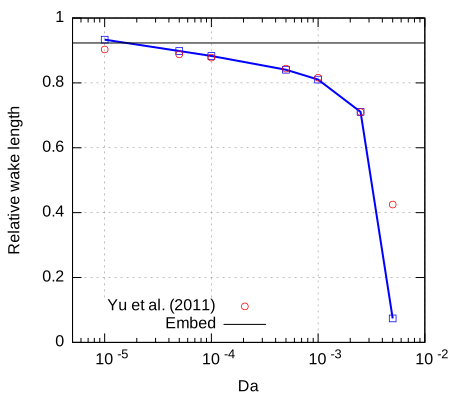
References
| [yu2011steady] |
Peng Yu, Yan Zeng, Thong See Lee, Xiao Bing Chen, and Hong Tong Low. Steady flow around and through a permeable circular cylinder. Computers & Fluids, 42(1):1–12, 2011. |