sandbox/popinet/contact/sessile-inclined.c
Sessile drop on an embedded boundary inclined at 45 degrees
This is a less trivial version of this test case.
set term push
set term @SVG size 480,480
set size ratio -1
unset key
unset xtics
unset ytics
unset border
plot 'out' w l, x + 0.97 with filledcurves x1 lc 'grey'
set term pop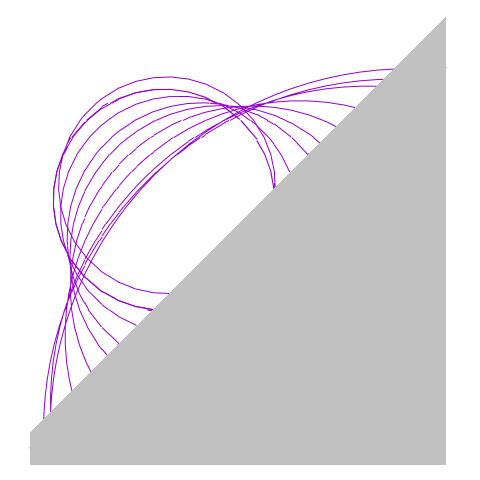
#include "grid/multigrid.h"
#include "embed.h"
#include "navier-stokes/centered.h"
#include "two-phase.h"
#include "tension.h"
#include "contact-embed.h"

double theta0;

int main()
{
  size (2.);
  origin (-1, 0);
We use a constant viscosity.
mu1 = mu2 = 0.1;We set the surface tension coefficient.
f.sigma = 1.;We vary the contact_angle.
  for (theta0 = 15; theta0 <= 165; theta0 += 15) {
    const scalar c[] = theta0*pi/180.;
    contact_angle = c;
    run();
  }
}

event init (t = 0)
{
We define the inclined wall and the initial (half)-circular interface.
  vertex scalar phi[];
  foreach_vertex()
    phi[] = (y - x - 0.97);
  boundary ({phi});
  fractions (phi, cs, fs);
  fraction (f, - (sq(x - 0) + sq(y - 1.) - sq(0.25)));
}

event logfile (i++; t <= 20)
{
If the curvature is almost constant, we stop the computation (convergence has been reached).
  scalar kappa[];
  curvature (f, kappa);
  foreach()
    if (cs[] < 1.)
      kappa[] = nodata;
  if (statsf (kappa).stddev < 1e-6)
    return true;
}
Given the radius of curvature R and the volume of the droplet V, this function returns the equivalent contact angle \theta verifying the equilibrium solution V = R^2(\theta - \sin\theta\cos\theta)
double equivalent_contact_angle (double R, double V)
{
  double x0 = 0., x1 = pi;
  while (x1 - x0 > 1e-4) {
    double x = (x1 + x0)/2.;
    double f = V - sq(R)*(x - sin(x)*cos(x));
    if (f > 0.)
      x0 = x;
    else
      x1 = x;
  }
  return (x0 + x1)/2.;
}

event end (t = end)
{
At the end, we output the equilibrium shape.
output_facets (f, stdout);We compute the curvature only in full cells.
  scalar kappa[];
  curvature (f, kappa);
  foreach()
    if (cs[] < 1.)
      kappa[] = nodata;

  stats s = statsf (kappa);
  double R = s.volume/s.sum, V = statsf(f).sum;
  fprintf (stderr, "%d %g %.5g %.3g %.4g\n", N, theta0, R/sqrt(V/pi), s.stddev,
	   equivalent_contact_angle (R, V)*180./pi);
}
We compare R/R_0 to the analytical expression, with R_0=\sqrt{V/\pi}.
The results are not very good, especially for small contact angles.
reset
set xlabel 'Contact angle (degrees)'
set ylabel 'R/R_0'
set arrow from 15,1 to 165,1 nohead dt 2
set xtics 15,15,165
plot 1./sqrt(x/180. - sin(x*pi/180.)*cos(x*pi/180.)/pi) t 'analytical', \
  'log' u 2:3 pt 7 t 'numerical'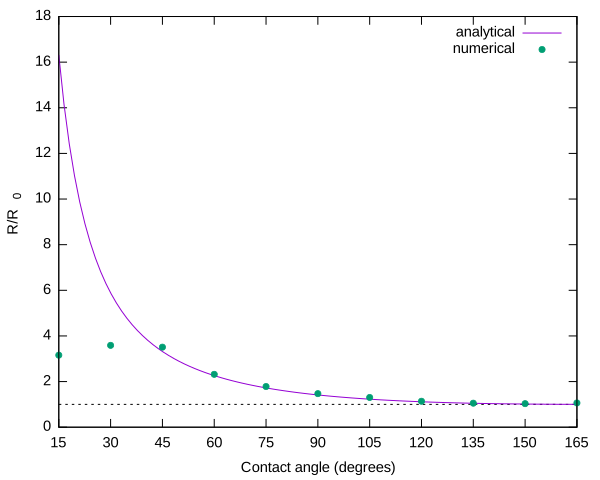
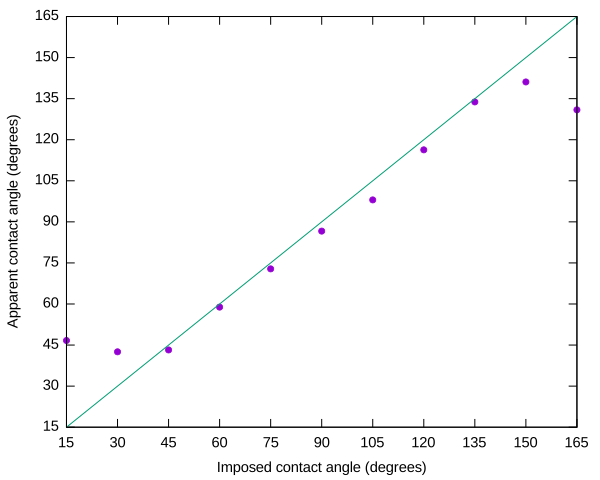
Another way to display the same result is to compare the “apparent contact angle” with the imposed contact angle. It is clear that contact angles smaller than \approx 45 degrees or larger than \approx 135 degrees cannot be imposed.
reset
set xlabel 'Imposed contact angle (degrees)'
set ylabel 'Apparent contact angle (degrees)'
unset key
set xtics 15,15,165
set ytics 15,15,165
plot 'log' u 2:5 pt 7, x