sandbox/jieyun/test/rising_ebit.c
Rising bubble
A two-dimensional bubble is released in a rectangular box and raises under the influence of buoyancy. This test case was proposed by Hysing et al, 2009 (see also the FEATFLOW page).
We solve the incompressible, variable-density, Navier–Stokes equations with interfaces and surface tension. We can solve either the axisymmetric or planar version. We can used standard or “reduced” gravity.
#define LEVEL 8
#define ADAPT 1

face vector av[];

#if AXIS
# include "axi.h" // fixme: does not run with -catch
#endif

#include "navier-stokes/centered.h"
#include "two-phase-ebit.h"
#include "tension.h"
The boundary conditions are slip lateral walls (the default) and no-slip on the right and left walls.
u.t[right] = dirichlet(0);
u.t[left]  = dirichlet(0);
We make sure there is no flow through the top and bottom boundary, otherwise the compatibility condition for the Poisson equation can be violated.
uf.n[bottom] = 0.;
uf.n[top] = 0.;

FILE * fp_dis;

int main() {
  TOLERANCE = 1e-4 [*];
  DT = 1.e-2 [0, 1];
  rho1 = 1000. [-3, 0, 1];
  mu1 = 10.;
  double sigma_in;

  #ifdef CASE2
  rho2 = 1.;
  mu2 = 0.1;
  sigma_in = 1.96;
  TOLERANCE = 1e-3 [*];
  DT = 1.e-3;
  #else
  rho2 = 100.;
  mu2 = 1.;
  sigma_in = 24.5;
  #endif

  f.sigma = sigma_in;

  size (2. [1]);
  init_grid (1 << LEVEL);
  a = av;

  run();
  fclose (fp_dis);
}


event init (i = 0) {
The domain is a rectangle. We only simulate half the bubble.
  mask (y > 0.5 ? top : none);

  vertex scalar phi[];
  foreach_vertex()
    phi[] = sq(x - 0.5) + sq(y) - sq(0.25);

  init_markers (phi);

  char name[80];
  sprintf (name, "rising_dis.dat");
  fp_dis = fopen (name, "w");
}
We add the acceleration of gravity.
event acceleration (i++) {
  foreach_face(x)
    av.x[] -= 0.98;
  boundary ((scalar *){av});
}


#if ADAPT
event adapt (i++) {
  adapt_wavelet ({mask_intf, u}, (double[]){0.02, 1e-3, 1e-3}, maxlevel = LEVEL, minlevel = LEVEL - 3);
}
#endif
We log the position of the center of mass of the bubble, its velocity and volume as well as convergence statistics for the multigrid solvers.
event logfile (i++) {
  double xb = 0., vb = 0., sb = 0.;
  foreach(reduction(+:xb) reduction(+:vb) reduction(+:sb)) {
    double dv = (1. - f[])*dv();
    xb += x*dv;
    vb += u.x[]*dv;
    sb += dv;
  }

  fprintf (fp_dis, "%g %g %g %g %g %g %g %g \n",
	  t, sb, -1., xb/sb, vb/sb, dt, perf.t, perf.speed);
  fflush (fp_dis);
}
At t=3 we output the shape of the bubble.
event interface (t = 3.) {
  char out[100];
  sprintf (out, "rising_intf_ebit.dat");
  output_facets_ebit (out);

  // reference file
  output_facets_ebit ("", stderr);
}
Results
The final shape of the bubble is compared to that obtained with the VOF method in the Basilisk Rising bubble test.
set term push
set term @SVG size 640,320
set size ratio -1
set grid
plot [][0:0.4]'https://basilisk.fr/src/test/rising/log' u 1:2 w l t 'Basilisk', \
              'rising_intf_ebit.dat' u 1:2 w l t 'EBIT'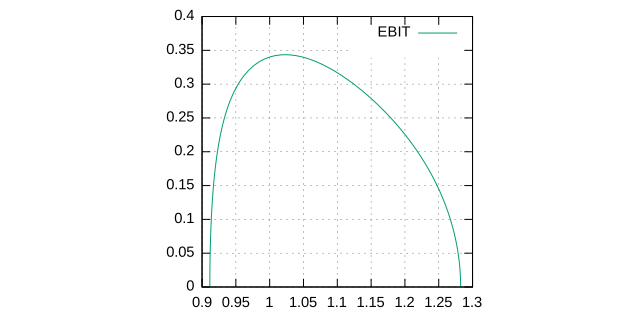
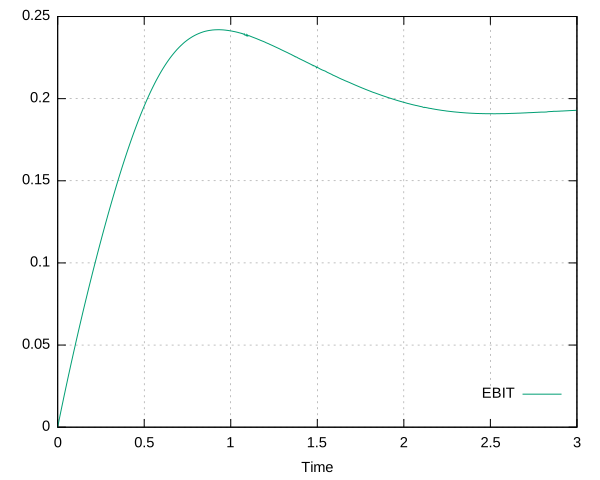
The agreement for the bubble rise velocity with time is also good.
set term pop
reset
set grid
set xlabel 'Time'
set key bottom right
plot [0:3][0:]'https://basilisk.fr/src/test/rising/out' u 1:5 w l t 'Basilisk', \
              'rising_dis.dat' u 1:5 w l t 'EBIT'