sandbox/jieyun/test/merging_3d_ebit.c
Three-dimensional bubble merging
This setup was adapted from Unverdi. See also Sussman for the same setup.
The flow is characterized by the Morton number (M) and Eotvos number (Eo, or Bond number Bo) \mathrm{Eo} = \rho_o g D^2 / \sigma \mathrm{M} = g \mu_o^4 / \rho_o / \sigma^3 The Galileo number (Ga) is an alternative of Morton number \mathrm{Ga} = \rho_o^2 g D^3 / \mu_o^2 = (\mathrm{Eo}^3/\mathrm{M})^{1/2}.
face vector av[];

#include "grid/multigrid3D.h"
#include "navier-stokes/centered.h"
#include "two-phase-ebit.h"
#include "tension.h"
#include "tag.h"
Free-slip boundary conditions are imposed at all domain boundaries.
uf.n[top] = 0.;
uf.n[bottom] = 0.;
uf.n[front] = 0.;
uf.n[back] = 0.;

int level = 6;
int case_id = 1;
double R = 0.25, xry = 0.5, width = 2. [1], R2;
double eo = 1.[0], mo = 1.[0], r_rho = 1.[0], r_mu = 1.[0];
double gra = 0.98;
FILE *fp_vel;

int main (int argc, char * argv[]) {
  if (argc > 1)
    level = atoi (argv[1]);

  DT = 1.e-3 [0,1];
  TOLERANCE = 1e-6 [*];
  rho1 = 1000. [-3,0,1];
  dimensions(nx = 2, ny = 1, nz = 1);

  eo = 50.;
  mo = 1.;
  r_rho = 20.;
  r_mu = 26.;

  f.sigma = rho1*gra*sq(2.*R)/eo;
  mu1 = sqrt(mo*rho1*cube(f.sigma)/gra);
  mu1 = sqrt(mu1);
  rho2 = rho1/r_rho;
  mu2 = mu1/r_mu;

  xry = 0.5 [1];

  size (width);
  init_grid (1 << level);
  a = av;

  run();
}

event init (i = 0) {
  R2 = R;
  coord xc1 = {0.5, 0.375, 0.5}, xc2 = {1.075, 0.625, 0.5};

  vertex scalar phi[];
  foreach_vertex() {
    double phi1, phi2;
    phi1 = sq(x - xc1.x) + sq(y - xc1.y) + sq(z - xc1.z) - sq(R);
    phi2 = sq(x - xc2.x) + sq(y - xc2.y) + sq(z - xc2.z) - sq(R2);
    phi[] = min(phi1, phi2);
  }

  init_markers (phi);

  eo = rho1*gra*sq(2.*R)/f.sigma;
  mo = gra*sq(mu1)*sq(mu1)/rho1/cube(f.sigma);
  if (pid() == 0) {
    printf ("Physical properties:\n");
    printf ("Density: %.4e %.4e, viscosity: %.4e %.4e\n", rho1, rho2, mu1, mu2);
    printf ("Surface tension: %.4e, gravity:%.4e\n", f.sigma, gra);
    printf ("Morton num.: %g  Eotvos num.: %g\n", mo, eo);
  }
}
We add the acceleration of gravity.
event acceleration (i++) {
  foreach_face(x)
    av.x[] -= gra;
  boundary ((scalar *) {av});
}
We log the position of the center of mass of the bubbles and their velocities.
bool has_merged = false;

event logfile (i+=4) {
  scalar d[];
  double yb = 0., vb = 0., sb = 0.;
  double yb_s[2] = {0., 0.}, vb_s[2] = {0., 0.}, sb_s[2] = {0., 0.};
  if (!has_merged) {
    foreach() {
      if (f[] < 1.e-4)
        d[] = 1.;
      else
        d[] = 0.;
    }
    int n = tag (d);

    if (n != 2)
      has_merged = true;
  }

  if (has_merged) {
    foreach(reduction(+: yb) reduction(+: vb) reduction(+: sb)) {
      double dv = (1. - f[])*dv();
      yb += x*dv;
      vb += u.x[]*dv;
      sb += dv;
    }
    yb_s[0] = yb_s[1] = yb;
    vb_s[0] = vb_s[1] = vb;
    sb_s[0] = sb_s[1] = sb;
  }
  else {
    foreach(reduction(+: yb) reduction(+: vb) reduction(+: sb)
      reduction(+: yb_s[:2]) reduction(+: vb_s[:2]) reduction(+: sb_s[:2])) {
      double dv = (1. - f[])*dv();
      yb += x*dv;
      vb += u.x[]*dv;
      sb += dv;
      int ind = (int) d[] - 1;
      if (ind >= 0) {
        yb_s[ind] += x*dv;
        vb_s[ind] += u.x[]*dv;
        sb_s[ind] += dv;
      }
    }
  }

  if (pid() == 0) {
    fprintf (stderr, "%.8e %.8e %.8e %.8e %.8e\n",
      t, yb_s[0]/sb_s[0], vb_s[0]/sb_s[0], yb_s[1]/sb_s[1], vb_s[1]/sb_s[1]);
  }
}
Output the shape of the bubble at diffrent time instants.
event interface (t = {0., 0.5, 1., 1.5, 1.7, 2.}) {
  // char name[80], name_con[80];
  // if (pid() == 0)
  //   printf ("Save interface (mesh) at time step:%d\n", i);
  // sprintf (name, "%srising_merge_3d_ebit_case%d_%d_%.1f.dat", \
  //   OUTPUTPATH, case_id, N, t);
// output_facets_semushin (name); // sprintf (name, "%srising_merge_3d_ebit_case%d_%d_%.1f_fem.dat", \
// OUTPUTPATH, case_id, N, t); // sprintf (name_con, "%srising_merge_3d_ebit_case%d_%d_%.1f_con.dat", \
// OUTPUTPATH, case_id, N, t);
// output_facets_semushin (name, tri = true, file_con = name_con);
}Results
set term pop
reset
set grid
set xlabel 't'
set key bottom right
plot [0:2.][0:] 'log' u 1:3 w l t 'Bubble 1', 'log' u 1:5 w l dt 2 t 'Bubble 2'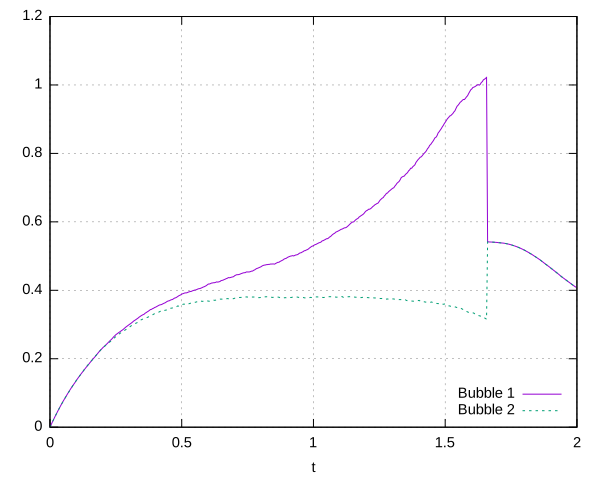
References
| [Sussman_2000_162] |
Mark Sussman and Elbridge Gerry Puckett. A coupled level set and volume-of-fluid method for computing 3D and axisymmetric incompressible two-phase flows. Journal of Computational Physics, 162(2):301–337, 2000. [ DOI ] |
| [Unverdi_1992_100] |
Salih Ozen Unverdi and Grétar Tryggvason. A front-tracking method for viscous, incompressible, multi-fluid flows. Journal of Computational Physics, 100:25–37, 1992. |