sandbox/fpicella/cylinder_plastron/karman_quantitative.c
Flow around a 2D cylinder at Re = 100
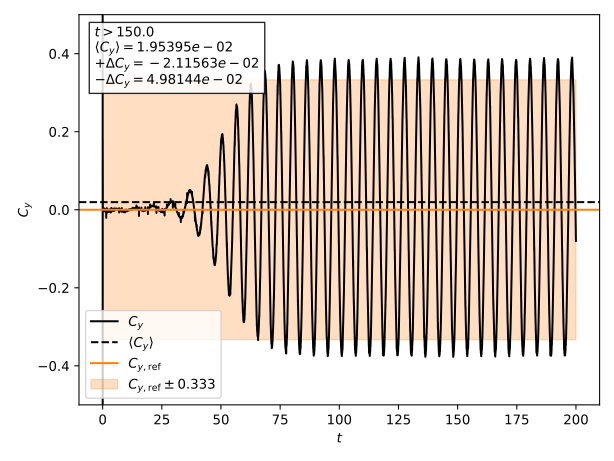
Some quantitative plots, drag (Cx) and lift (Cy). With some simple plotting options. Largely taken from karman.c case.
Reference values are taken from Legendre et al. 2009.
Animation of the vorticity field.
//#include "grid/multigrid.h"
#include "grid/quadtree.h"
#include "embed.h"
#include "navier-stokes/centered.h"
#include "two-phase.h"
//#include "tension.h"
//#include "tavares/contact-embed.h"
#include "view.h"

#define R0 0.5 // solid cylinder radius
//#define R1 0.55 // plastron cylinder radius
#define xc 0.
#define yc 1.
#define endTime 200.

double theta0, volume_vof_init;
int MAXLEVEL = 9;
int MINLEVEL = 4;

double Reynolds = 100.;

int main() {
  size (32.);
We set the origin
  origin (-8, -L0/2.); // at least 8 diameters beyond the inlet face
											 // so to avoid influence of confinement...

  init_grid (1 << MAXLEVEL);
We use a constant viscosity.
mu2 = 1.*R0*2./Reynolds; // outer fluid viscosityWe set plastron viscosity equal to 1/100 of the main fluid one.
mu1 = 1.*mu2; // plastron viscosityWe set the surface tension coefficient.
//  f.sigma = 1.;

//
// Set a constant contact angle.
//	const scalar c[] = 10.*pi/180.; // fixed contact angle...
//	contact_angle = c;

	run();
}
We set the boundary conditions, so to obtain a flow around a fixed cylinder.
u.n[left]  = dirichlet(1.0);
p[left]    = neumann(0.);
pf[left]   = neumann(0.);

u.n[right] = neumann(0.);
p[right]   = dirichlet(0.);
pf[right]  = dirichlet(0.);
Must impose no-slip on embedded boundaries!
We define the solid cylinder (EMBED) and fluid cylinder (PLASTRON) interface.
  solid (cs, fs, (sq(x - xc) + sq(y - yc) - sq(R0)));

//  fraction (f, - (sq(x - xc) + sq(y - yc) - sq(R1)));
}

event adapt (i++) {
  adapt_wavelet ({cs,u,f}, (double[]){1e-2,1e-2,1e-2,1e-1}, MAXLEVEL, MINLEVEL);
}

//event movie(i+=10,t<=T){
//  view(fov=5, tx = 0, ty = 0);
//  draw_vof("cs", "fs",filled = -1);
//  //draw_vof ("f", filled = 1, fc = {1,0,0});
//	draw_vof ("f", lc = {1, 0, 0}, lw = 2);
//	squares ("u.x", linear = true);
//	// Draw grid only on upper part of flow
//	cells (lc = {0.7, 0.7, 0.7});
//
//
//  save("movie.mp4");
//}

event compute_forces (i += 1, t<=endTime)
{
  coord Fp, Fmu;
  embed_force (p, u, mu, &Fp, &Fmu);
// Output forces
  static FILE * fp = NULL;
	if(pid()==0){
  	if (!fp) {
  	  fp = fopen ("force_coeff.dat", "w");
  	  fprintf (fp, "# i t dt Cx Cy\n");
  	}
		double Cx = (Fp.x+Fmu.x)*2.;
		double Cy = (Fp.y+Fmu.y)*2.;
  	fprintf (fp, "%06d %+6.5e %+6.5e %+6.5e %+6.5e\n",
  	         i, t, dt, Cx, Cy);
  	fflush (fp);
	}
}


event movies (i += 10)
{
  scalar omega[], m[];
  vorticity (u, omega);
  foreach()
    m[] = cs[] - 0.5;
  output_ppm (omega, file = "vort.mp4", box = {{-0.5,-0.5},{7.5,0.5}},
	      min = -10, max = 10, linear = true, mask = m);
}
import numpy as np
import matplotlib.pyplot as plt
# columns:
# i t dt Cx Cy
i,t,dt,Cx,Cy = np.loadtxt('force_coeff.dat', comments='#', unpack=True)
tTarget = 150.
m = t > tTarget
tt = t[m]
xx = Cx[m]
Cxmean = np.mean(xx)
# local maxima/minima around the mean
imax = np.where((xx[1:-1] > xx[:-2]) & (xx[1:-1] > xx[2:]))[0] + 1
imin = np.where((xx[1:-1] < xx[:-2]) & (xx[1:-1] < xx[2:]))[0] + 1
Cxplus = np.mean(xx[imax] - Cxmean)
Cxminus = np.mean(Cxmean - xx[imin])
print('Average Cx for t > %.1f = %+6.5e' % (tTarget, Cxmean))
print('Average positive peak = %+6.5e' % Cxplus)
print('Average negative peak = %+6.5e' % Cxminus)
print('Cx = %+6.5e +%+6.5e -%+6.5e' % (Cxmean, Cxplus, Cxminus))
# literature reference
Cxref = 1.38
Cxerr = 0.012
plt.figure()
plt.plot(t, Cx, 'k-', label=r'$C_x$')
plt.axhline(Cxmean, color='k', linestyle='--',
label=r'$\langle C_x\rangle$')
plt.axhline(Cxref, color='C1', linestyle='-',
label=r'$C_{x,\mathrm{ref}}$')
plt.fill_between(t, Cxref - Cxerr, Cxref + Cxerr,
color='C1', alpha=0.25,
label=r'$C_{x,\mathrm{ref}}\pm 0.012$')
plt.xlabel(r'$t$')
plt.ylabel(r'$C_x$')
plt.text(0.97, 0.97,
r'$t > %.1f$' '\n'
r'$\langle C_x\rangle = %.5e$' '\n'
r'$+\Delta C_x = %.5e$' '\n'
r'$-\Delta C_x = %.5e$'
% (tTarget, Cxmean, Cxplus, Cxminus),
transform=plt.gca().transAxes,
ha='right', va='top',
bbox=dict(facecolor='white', alpha=0.85))
plt.ylim(1.1, 1.5)
plt.legend(loc='lower right')
plt.tight_layout()
plt.savefig('Cx_evolution.svg')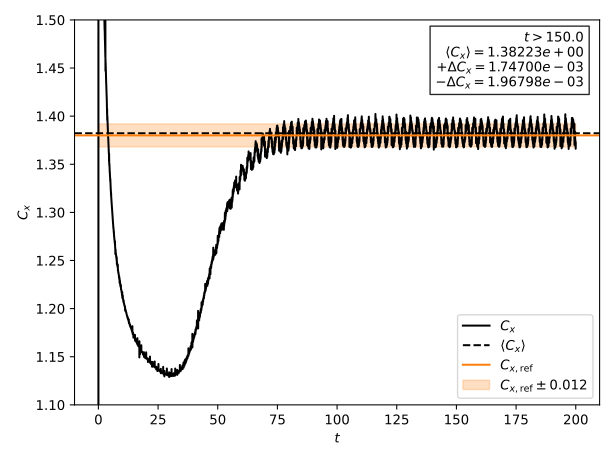
import numpy as np
import matplotlib.pyplot as plt

# columns:
# i t dt Cx Cy
i,t,dt,Cx,Cy = np.loadtxt('force_coeff.dat', comments='#', unpack=True)

tTarget = 150.

m = t > tTarget
tt = t[m]
yy = Cy[m]

Cymean = np.mean(yy)

# local maxima/minima around the mean
imax = np.where((yy[1:-1] > yy[:-2]) & (yy[1:-1] > yy[2:]))[0] + 1
imin = np.where((yy[1:-1] < yy[:-2]) & (yy[1:-1] < yy[2:]))[0] + 1

Cyplus  = np.mean(yy[imax] - Cymean)
Cyminus = np.mean(Cymean - yy[imin])

print('Average Cy for t > %.1f = %+6.5e' % (tTarget, Cymean))
print('Average positive peak   = %+6.5e' % Cyplus)
print('Average negative peak   = %+6.5e' % Cyminus)
print('Cy = %+6.5e +%+6.5e -%+6.5e' % (Cymean, Cyplus, Cyminus))

# literature reference
Cyref = 0.
Cyosc_ref = 0.333

plt.figure()
plt.plot(t, Cy, 'k-', label=r'$C_y$')

plt.axhline(Cymean, color='k', linestyle='--',
            label=r'$\langle C_y\rangle$')

plt.axhline(Cyref, color='C1', linestyle='-',
            label=r'$C_{y,\mathrm{ref}}$')

plt.fill_between(t, Cyref - Cyosc_ref, Cyref + Cyosc_ref,
                 color='C1', alpha=0.25,
                 label=r'$C_{y,\mathrm{ref}}\pm 0.333$')

plt.xlabel(r'$t$')
plt.ylabel(r'$C_y$')

plt.text(0.03, 0.97,
         r'$t > %.1f$' '\n'
         r'$\langle C_y\rangle = %.5e$' '\n'
         r'$+\Delta C_y = %.5e$' '\n'
         r'$-\Delta C_y = %.5e$'
         % (tTarget, Cymean, Cyplus, Cyminus),
         transform=plt.gca().transAxes,
         ha='left', va='top',
         bbox=dict(facecolor='white', alpha=0.85))

plt.ylim(-0.5, 0.5)
plt.legend(loc='lower left')
plt.tight_layout()

plt.savefig('Cy_evolution.svg')